.jpg)

Product Strategy Workshops for Tech Teams
At certain stages, founders and product teams need to step back and answer strategic questions: what can make the business stronger over time, how to scale it, and which assumptions need to be tested before investing further.
At JetStyle, we explore these challenges through expert-led product strategy workshops with Alexey Kulakov, CEO and co-founder of JetStyle.
Alexey has been designing digital products and human interactions since 1992. He has built companies and products, worked as a CPO, mentored startups and corporate teams, and taught product management, strategy, and leadership. Today, he conducts workshops and educational sessions for founders, product leaders, and technology teams in Europe.
The format is particularly relevant for B2B startups moving beyond the MVP stage, corporate spin-offs and internal startups, and teams preparing for growth or investment. Rather than discussing product frameworks in isolation, participants bring their own business challenges and work through them together.
Why Defensibility Became an Early-Stage Product Question
One of Alexey’s recent workshops focused on economic moats — sustainable competitive advantages that become stronger as a business grows.
The topic itself is not new. What has changed is when technology companies need to think about it.
A few years ago, a startup could validate a problem–solution fit, find a performing distribution channel, build the product, and still have months before competitors could reproduce the same approach. AI has shortened that window dramatically. Once a useful product starts gaining traction, similar solutions can appear much faster.
This adds another question for founders and investors. It is no longer enough to demonstrate demand and a viable acquisition channel. Teams also need an early answer to: what will make this business increasingly difficult to copy over time?
This creates a methodological challenge. A real moat cannot be built in a week — by definition, it needs to accumulate over time. But startups need a way to test much earlier whether the business has the potential to develop one.
This contradiction became the starting point for Alexey’s Moat workshop and research organized by IT People, an international IT HR Agency.
.png)
Turning the Question Into a Workshop
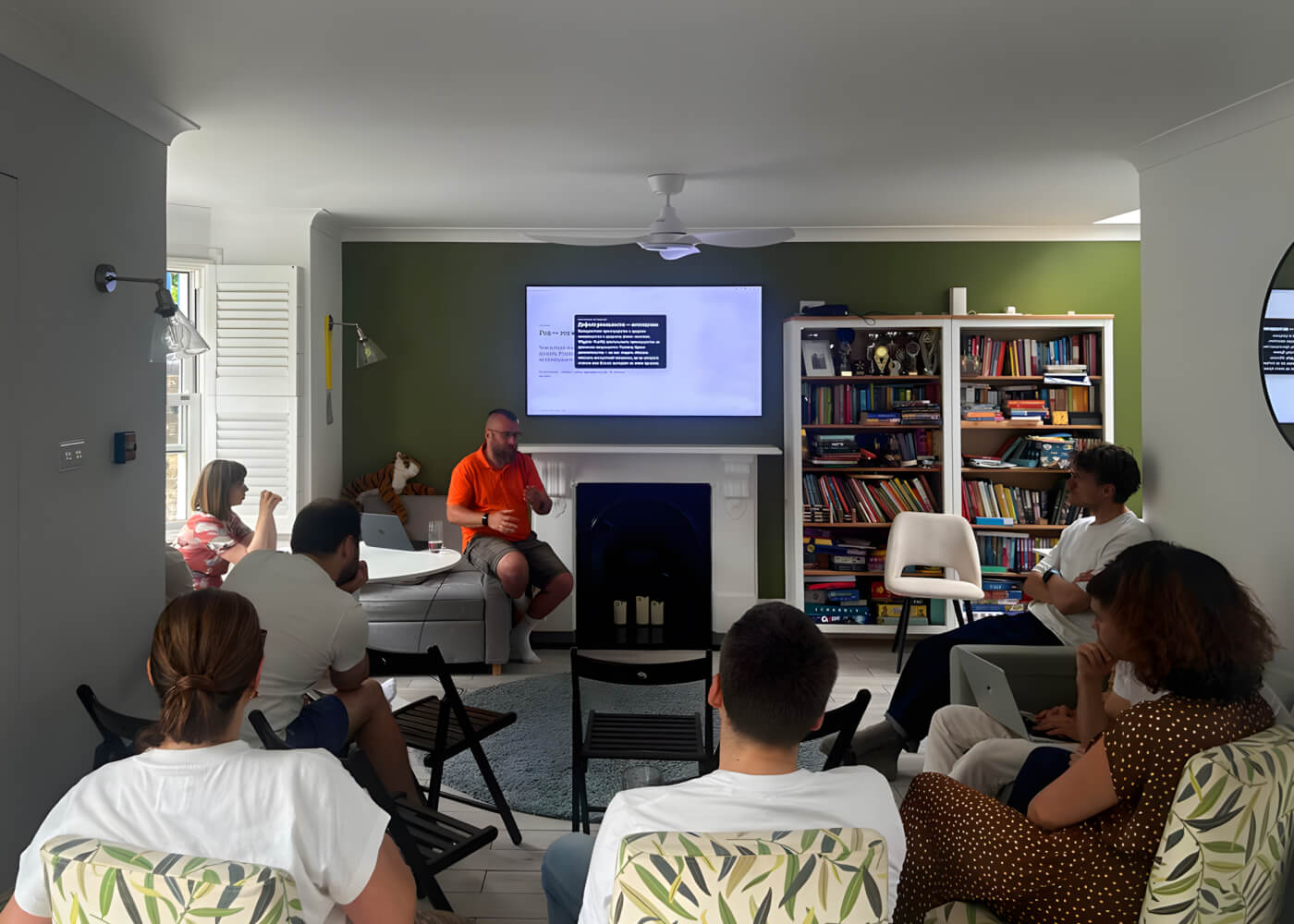
The workshop was built as an interactive laboratory rather than a lecture. Participants worked with 21 canonical moat examples from well-known companies, including “evil twins” — similar-looking advantages that helped distinguish real accumulation mechanisms from those that only appear defensible.
They also explored Moats 2026, Alexey’s research into current types of business defensibility, including what has changed in emerging technology areas and how new competitive advantages tend to combine existing moat mechanisms.
.jpg)
Then participants applied the framework to their own businesses. Using a dedicated team worksheet, each group spent 2–3 hours building a moat model for its case, challenging the assumptions behind it, and defining an early metric that could indicate whether the advantage was actually strengthening.
The goal was to leave with something that could be tested after the workshop: a concrete moat hypothesis, an early metric, and a clearer understanding of what needs to accumulate as the business grows.
Product Thinking in the Age of AI
Alexey and the JetStyle team are active advocates of practical AI adoption. Today, AI can take on a significant part of research, brainstorming, hypothesis exploration, and preparation — while people remain responsible for judgment, decisions, and the quality of the final result.
The Moat workshop itself is an example of this approach. Alongside the live session, Alexey turned the methodology into an executable skill for Claude Code. Teams can install it, apply the same workshop logic to their own business, and independently go through the moat validation process, with AI guiding the steps and challenging their assumptions.
This is how we approach AI at JetStyle more broadly: as a way to package expertise, accelerate analytical work, and make useful methodologies easier to reuse: https://jet.style/articles-ai
Bring a Product Challenge to the Table
The Moat workshop is one example of a broader format. Alexey works with founders, product leaders, and technology teams on product strategy, startup scaling, innovation, and the challenges that appear when a digital business moves to its next stage.
A workshop can be built around your team’s actual product, business model, and current strategic questions — bringing Alexey’s product experience into the room rather than applying a generic training program.
If your team is based in Europe and has a product challenge worth examining from a different angle, let’s design a workshop around it.